The Science Behind Watercolor Textures in AI Art: How Neural Networks Paint
Why does 'watercolor style' actually work in an AI prompt? Understanding the technical mechanism behind aesthetic keywords helps you use them far more effectively.
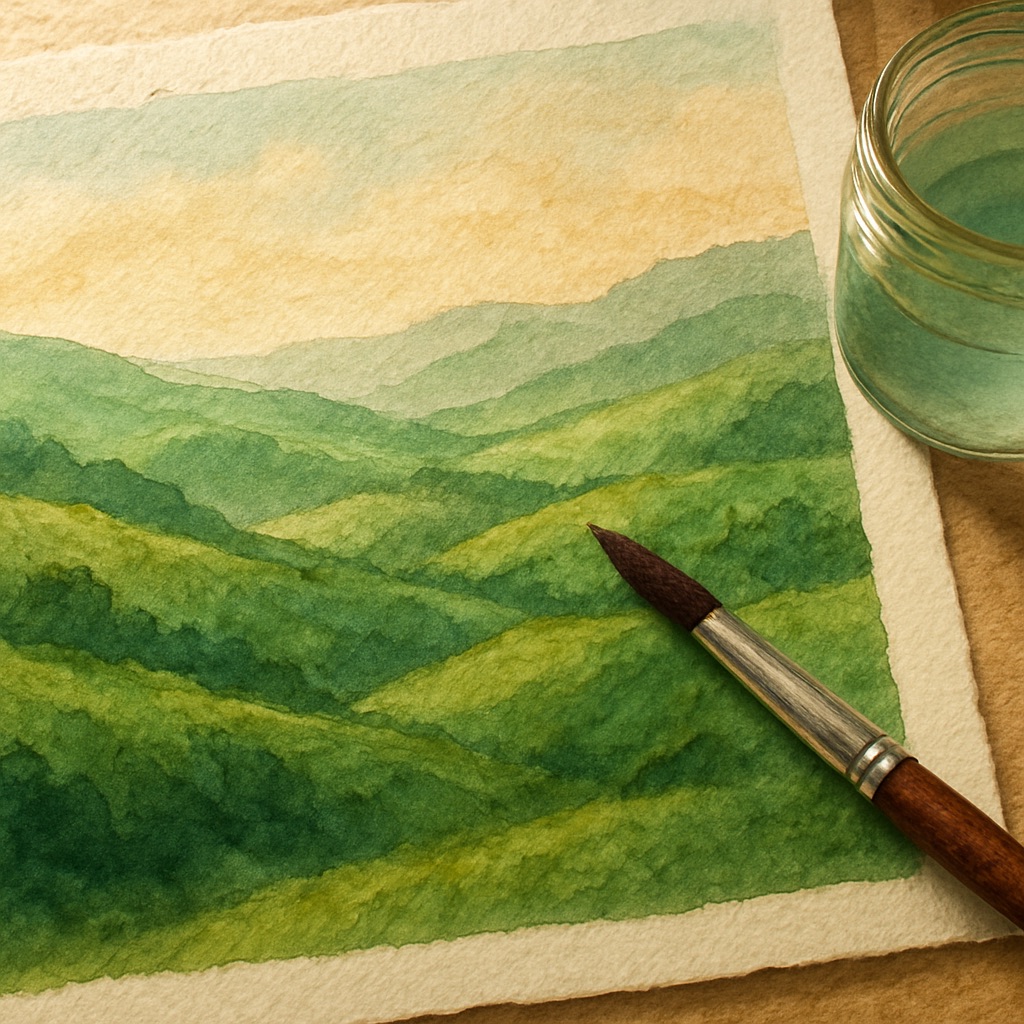
When you type 'watercolor texture' into an AI image generator and watch the output transform from a flat digital rendering into something that looks genuinely hand-painted, it can feel like magic. It isn't magic — it's a fascinating technical process involving billions of learned statistical associations. Understanding how this process actually works will make you significantly better at prompting.
How Diffusion Models Learn Visual Styles
Modern AI image generators use a technique called diffusion modeling. In training, the model is shown millions of images paired with text descriptions. Over billions of iterations, it learns which visual patterns co-occur with which textual descriptions. When you type 'watercolor,' the model activates the statistical cluster associated with all the watercolor-tagged images in its training data — soft bleeding pigment edges, granulation textures, visible paper grain, translucent layering, and the particular color desaturation of pigment-on-wet-paper.
Why Specificity Dramatically Improves Results
The keyword 'watercolor' alone activates a broad cluster that includes everything from children's book illustrations to professional botanical prints to loose urban sketches. When you add 'gouache background painting' or 'traditional Japanese watercolor technique,' you activate more specific sub-clusters within the model's learned representations, steering the output toward a much narrower range of visual patterns. This is why specificity isn't just aesthetically helpful — it's technically meaningful.
The Role of Training Data in Aesthetic Bias
AI models have aesthetic biases built directly into their training data. If the training dataset contained significantly more high-saturation anime imagery than vintage painted animation, the model will default to the more heavily represented style when given ambiguous prompts. Understanding this explains why your 'anime art' prompt keeps producing hyper-modern results — you're triggering the dominant cluster, not the niche you're targeting.
This also explains why era-specific keywords are so powerful. Terms like '1990s anime,' 'vintage animation cel,' or 'pre-digital Japanese illustration' activate statistical clusters associated with older training data — images from an era when animation was literally painted by hand.
Leveraging CLIP Embeddings for Better Prompts
Most modern image generators use a CLIP (Contrastive Language–Image Pretraining) model to map your text prompt to a vector representation in a shared text-image space. This means the model understands semantic similarity, not just keyword matching. 'Hand-painted brushwork' and 'visible paint application' activate similar semantic spaces, and using both reinforces the cluster activation. This is the technical reason why repetition and synonym stacking in prompts can improve results.
Practical Implications for Prompt Engineering
- ✦Use medium-specific terms: 'gouache,' 'watercolor,' 'ink wash' activate different visual clusters than the generic 'painted' or 'art.'
- ✦Specify era: 'vintage 1990s animation' pulls from an older, more painterly cluster than 'anime art.'
- ✦Use synonym stacking for critical qualities: 'soft edges, diffused light, gentle blur, atmospheric haze' all reinforce the same soft-lighting cluster.
- ✦Understand that negative prompts work by mathematically deactivating statistical associations — they're not just suggestions.
- ✦Geographic style descriptors ('Japanese illustration,' 'European watercolor tradition') activate geographically associated training clusters.